Built by scientists and driven by data, these techniques are practical, affordable, and scalable. The solutions are tested directly on coffee farms, supporting the communities that the coffee industry depends on.

“Falcon Coffees partnered with the University of Brighton to build an accurate Greenhouse Gas Emissions model for smallholder coffee farms. Over the thirty-six months of this project, we identified a critical gap in current climate measurement capabilities: the science does not exist, and the primary data is not available to map adaptive practices towards building resilience at an individual farm level.
Falcon On-Farm was established to address this challenge through a science-led and data-driven approach on an open-source basis. We will collaborate with individuals and institutions within the global sustainability community who participate in this body of work.”
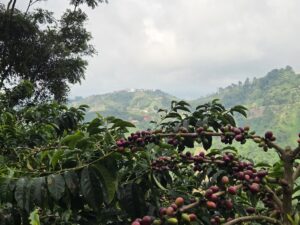
Coffee grows in the tropical belt across Africa, Asia and Latin America. An estimated 12.5 million smallholder coffee farmers produce most of the world’s coffee in 50 of the world’s least developed countries.
Smallholder farmers are vulnerable to climate change. Already we see coffee farms being impacted with shifting seasons, erratic weather patterns, increased incidences of pests and diseases – all of which impact coffee yield and quality.
The coffee industry is facing an existential crisis. Where will the future supply of coffee come from, upon which our entire industry relies?
Coffee farms need to be resilient in the face of climate change.
We need to build new business models that include direct investment in building farmer resilience.
Our goal is to support our coffee producers, on whom our industry depends, to help bolster the health and resilience of their farms.
Discussions with our coffee producers have highlighted the priorities of the community which focus on the need to reduce soil degradation, biodiversity loss, dependence on agrochemicals, and vulnerability to climate change.
Falcon On-Farm is where we are investing in building adaptive farming practices to face the dynamic threat of a changing climate.
Great science on coffee and climate exists, but there is a disconnect between the theory and actionable techniques that work for smallholder coffee farms.
Regenerative agricultural includes practices that are designed to create healthy ecosystems, building resilience to shocks such as climate change.
Regenerative agriculture is excellent in principle; however, regen ag is not created for coffee specifically and there is little practical guidance on adapting these techniques to smallholder coffee farmers. We want to help close the knowledge gap from theory to practice, providing technical assistance
and education to producers and the farming community on how regenerative agriculture can be successful on smallholder coffee farms.
Falcon On-Farm has been established to address this challenge through a science-led and data-driven approach aimed at developing scalable practices for smallholder coffee farmers that enhance resilience to climate change.
The programme will focus on comprehensive soil health assessments and the restoration of the soil microbiome, with the aim of improving plant health, productivity and quality.
For Falcon, if we are to secure our economic survival as a coffee company, we need to invest in the health and resilience of the coffee growing communities with whom we work. We have held this view since the business started in 2008.
We participate in a variety of sustainability initiatives across the world.
What we have learned is that the science, data and technologies to measure GHG emissions at an individual farm level need more input.
The variables from one farm to the next are too great. So very little primary data has historically been collected, making accurate predictions unrealistic.
The emissions model we did build looked at the silos of emission-generating and sequestrating activities: water, soil, shade trees, fertilizers and processing methods.
When you consider those silos, Dr Mandi -Caudill is walking our work into the realms of regenerative agriculture.
Falcon On-Farm is what we are calling this next body of work. It will be science-led and data driven, focused on building viable, affordable farming techniques that build resilience through adaption to climate impact.
Our work has begun in Colombia and Peru, where we have experienced agronomists already working with communities that Falcon has sourced coffee from for a number of years. The trust already exists.
We are starting with soil, the foundation.
We have enlisted the help of Sam Knowlton, a soil scientist with many years’ experience in regenerative agriculture.
Sam and Mandi have designed a program to assess soil health, to map out the introduction of macro and micro nutrients and key minerals to help rebuild the soil microbiome.
These inputs are locally available and affordable.
As soil structure and health improves, plant health will improve, supporting yield and quality. Reliance on synthetic fertilisers, herbicides, pesticides and fungicides will reduce, supporting biodiversity.
Food crops and other cash crops will benefit at a broader community level.
Our scientists will collect primary data to track outcomes and best practices. To translate our vision into measurable impact, we begin with a clear set of key action items:
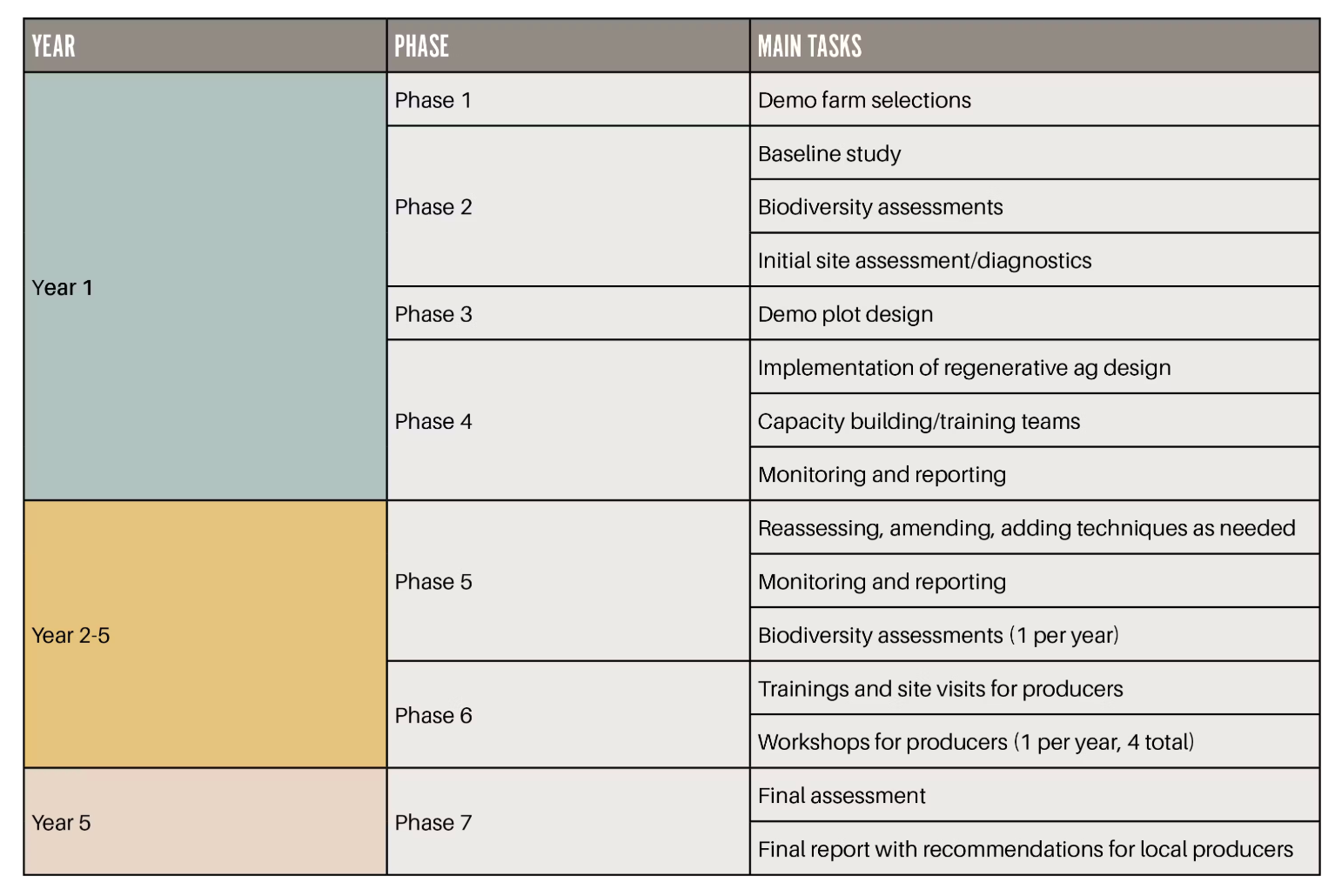
This type of project requires long-term commitment with the right planning and expertise. This is a 5-year project that includes the following elements:
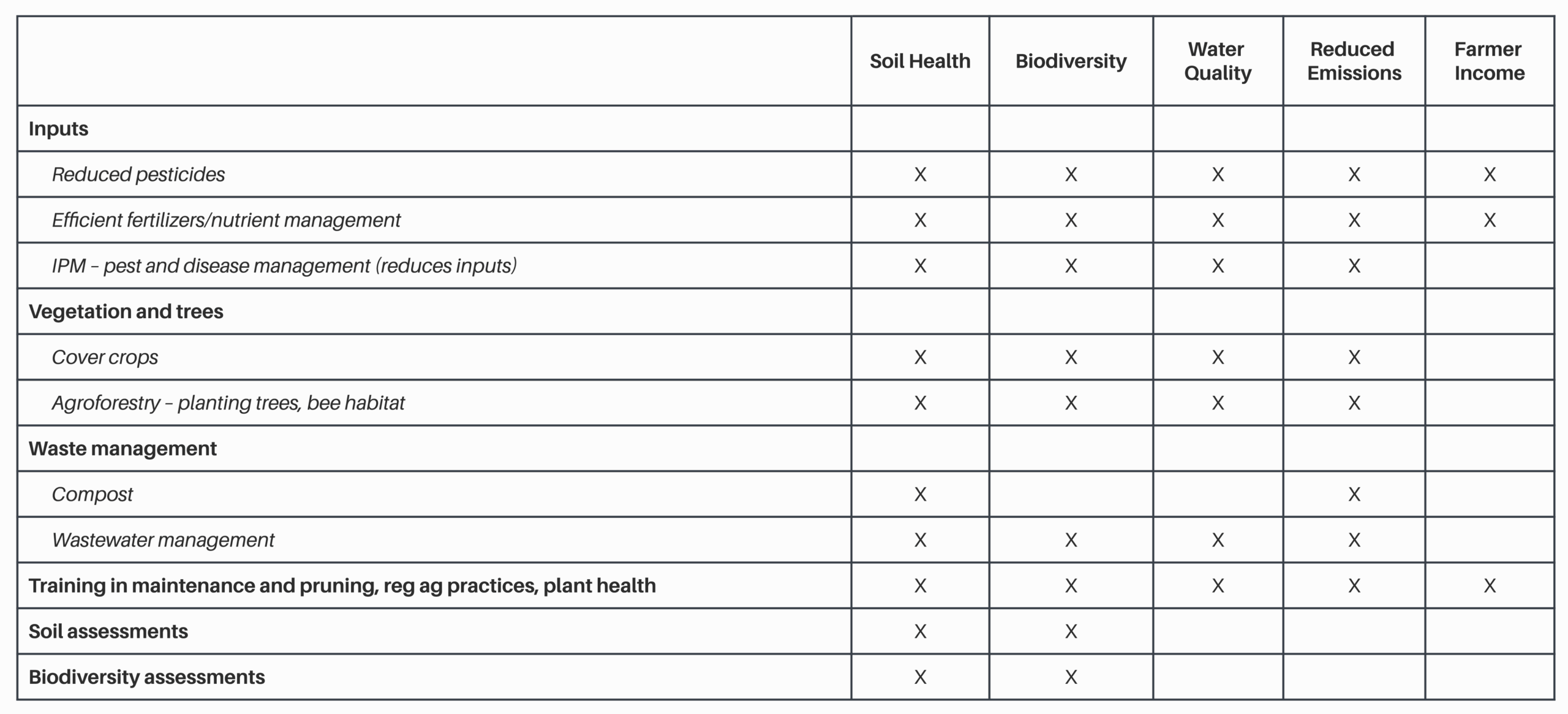
The aim is to demonstrate successful agricultural practices and to measure the impacts of these in terms of:
While we have concrete goals, we have set no deadlines. Climate change is dynamic. Our approach needs to reflect this state of constant change.
So Falcon On-Farm is a place of ongoing learning within a community, aimed at building resilience through to constant adaption in response to ongoing change, however long the cycle.
Our work is a contribution to a global conversation. For this reason, Falcon On-Farm will be open- source. Our scientists will make the data, the facts, the failures and the successes, openly available to partners, people and institutions who value this work.
We want to create a place of open dialogue and sharing, across crops, disciplines and institutions, both public and private, for-profit and non-profit.
An open ledger, with entries from everyone with a contribution to make, owned by no one.
Scientific truth, established with empirical data, providing real-world practices for smallholder farmers, specific to their location and needs.
For adoption, we already have proof of concept. In 2019, Falcon employed agronomists in Peru, providing training on Good Agricultural Practices and teaching the science of coffee processing to optimise quality.
The critical component is that Falcon is the buyer of coffee, offering price premiums in recognition of the quality improvement.
These coffees feed Falcon’s exploding demand for high quality speciality coffees.
For those farmers that work with us, we are always a buyer of their coffee, should they choose to sell to us.
For those lead farmers hosting the demonstration plots for Falcon On-Farm, Falcon will underwrite any loss of income due to lower yield or lower quality.
To build scale, we have started conversations with organisations in our network.
Technoserve, with 4000 demonstration plots in coffee communities across the world, has expressed interest in sharing and adopting our learnings across their places of education.
THE NEED FOR FINANCIAL INVESTMENT IN FALCON ON-FARM
What is needed now is essential financial support for Falcon On-Farm, an endorsement from leading impact investors that this work is important and worthy of collaborative participation and support.